If you have been accused of a white-collar crime in Freehold or Point Pleasant, the stakes are high and your future is on the line. White-collar crime charges can result in life-changing consequences, from steep fines to incarceration, and can damage your reputation both personally and professionally. In Monmouth County, Ocean County, and throughout the state of New Jersey, prosecutors take these charges seriously and often dedicate significant resources to pursuing convictions. That is why having an experienced white-collar crime attorney from Mallon and Tranger on your side is essential.
Our
criminal defense team provides aggressive, strategic representation for clients in Freehold, Point Pleasant, and surrounding areas such as Asbury Park, Long Branch, Toms River, and Brick. We understand how white-collar crime allegations can disrupt every aspect of your life. Whether you are a professional, a business owner, or simply someone caught up in an investigation, we are here to defend your rights and work toward the best possible outcome in your case.
What Is White-Collar Crime?
In New Jersey, white-collar crime refers to a broad category of non-violent offenses that are primarily motivated by financial gain and often occur in professional, corporate, or business settings. These crimes are typically built on some form of fraud, deception, misrepresentation, or breach of trust, with the goal of securing money, property, or a personal advantage. While they do not involve physical harm in the way
violent crimes do, the impact of white-collar crimes can be far-reaching, resulting in significant financial losses for victims and severe legal consequences for those accused.
In Freehold, Point Pleasant, and communities throughout Monmouth County and Ocean County, prosecutors and law enforcement agencies treat white-collar crime allegations seriously, often investing considerable time and resources into building their cases. Even without any allegation of violence, a conviction can result in heavy fines, restitution orders, probation, prison time, and a lasting criminal record. Beyond legal penalties, the reputational damage from a white-collar crime conviction can affect career prospects, personal relationships, and professional licensing for years to come.
Common Types of White-Collar Crime in New Jersey
White-collar crime charges in Freehold, Point Pleasant, and surrounding areas can involve a variety of alleged offenses, including but not limited to:
Fraud: Fraud is one of the most common categories of white-collar crime and can take many forms. In New Jersey, charges often include:
- Insurance fraud: Providing false information to an insurance company to receive payment or benefits.
- Mortgage fraud: Misrepresenting facts on loan applications or real estate transactions.
- Healthcare fraud: Submitting false claims to government programs or private insurers.
- Credit card fraud: Using stolen or counterfeit card information to make purchases or withdraw funds.
Embezzlement: This occurs when a person entrusted with money or property misappropriates it for personal use. In Freehold and Point Pleasant, embezzlement charges frequently arise in situations involving business employees, accountants, or corporate officers accused of siphoning funds from company accounts.
Identity Theft: Stealing or unlawfully using another person’s personal information, such as Social Security numbers or bank account details, to commit fraud or other crimes. In Monmouth County and Ocean County, identity theft cases have grown alongside the increase in online transactions and data breaches.
Forgery: Altering, creating, or signing a document with the intent to deceive, such as falsifying checks, contracts, or identification.
Securities Violations: Misrepresenting financial information, engaging in deceptive investment schemes, or participating in insider trading. While securities-related offenses are less common than other forms of white-collar crime in smaller communities, they can still occur in professional sectors throughout New Jersey.
Bribery and Corruption: Offering, giving, receiving, or soliciting something of value in exchange for influencing a public or private decision. This can involve public officials, contractors, or corporate executives.
Theft by Deception: Using misleading statements or false promises to obtain property, services, or funds from another person.
Computer Crimes and Cyber-Related White Collar Offenses: In today’s digital age, many white-collar crimes in Freehold, Point Pleasant, and other parts of Monmouth County and Ocean County involve the use of technology. Under New Jersey law, computer-related crimes can include:
- Unauthorized access to computer systems: Hacking into systems without permission to obtain data or disrupt operations.
- Phishing and email scams: Tricking victims into revealing sensitive information.
- Online fraud schemes: Selling fake products or services over the internet.
- Data breaches: Stealing or misusing confidential business or personal data.
Related: Types of cyber crime and defenses if caught
Technology-driven crimes often leave a trail of digital evidence, which can be used by prosecutors to strengthen their cases. These offenses can also cross into multiple jurisdictions, meaning that even when the alleged crime occurs locally in Freehold or Point Pleasant, it can have far-reaching consequences within New Jersey’s legal system.
How White-Collar Crimes Are Classified in New Jersey
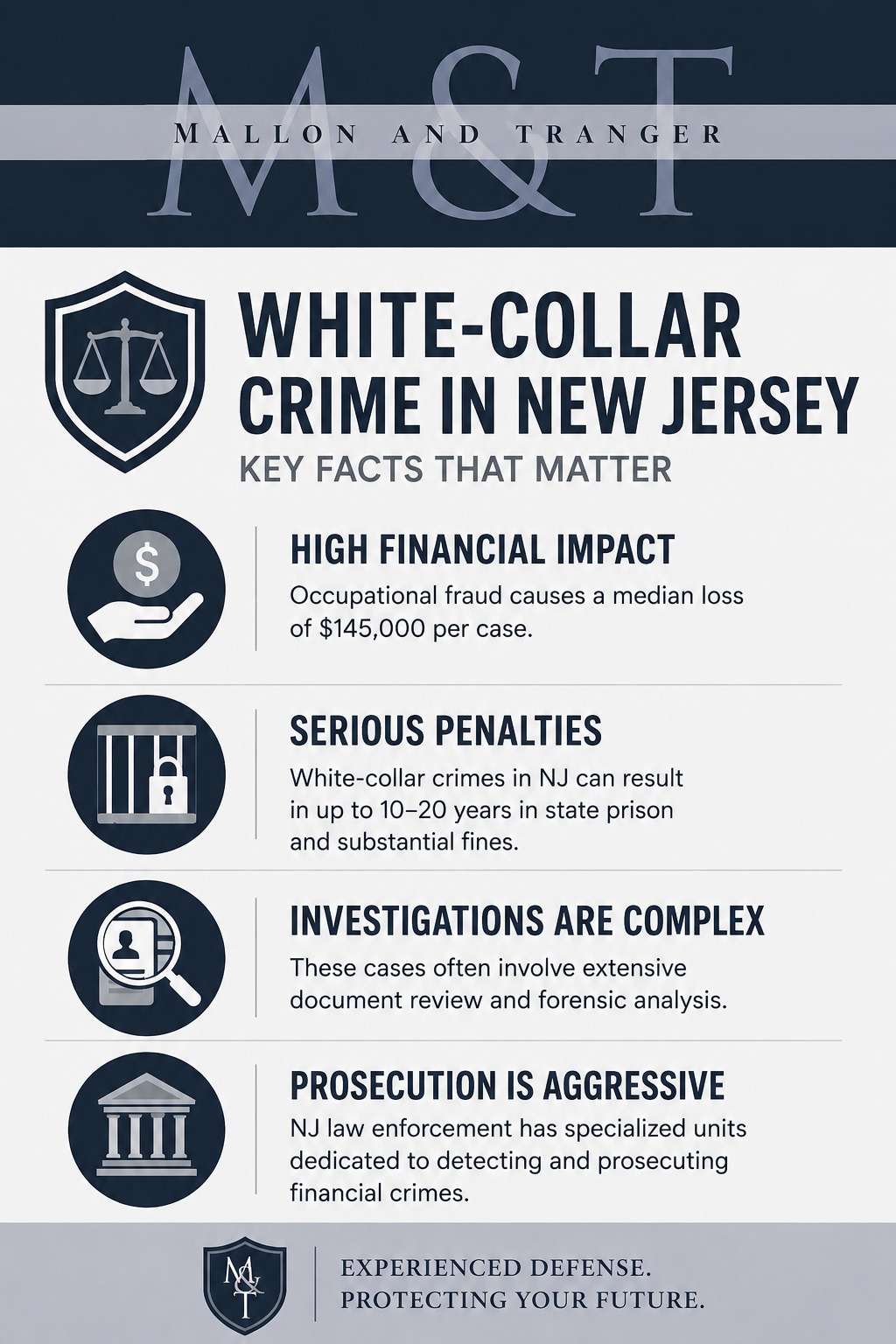
In New Jersey, white-collar crimes are prosecuted under state statutes that set forth specific penalties based on the circumstances and the monetary value of the alleged loss. Charges are typically classified as either:
- Disorderly persons offenses: Less severe, often involving smaller amounts of money, but still carrying the potential for jail time, fines, and a criminal record.
- Indictable crimes: More serious charges, similar to felonies in other states, which can result in years of incarceration and significant financial penalties.
The classification often depends on factors such as:
- The value of the property or funds involved.
- Whether the crime involved a breach of public trust.
- The number of victims affected.
- Whether technology was used to commit the offense.
Because the penalties escalate with the scope of the alleged offense, anyone accused of white-collar crime in Freehold, Point Pleasant, or other areas of Monmouth County and Ocean County should seek legal counsel immediately to understand the charges and build a defense strategy.
Potential Consequences and Penalties of White-Collar Crimes
Facing a white-collar crime charge in Freehold, Point Pleasant, or anywhere in Monmouth County or Ocean County is not something to take lightly. Even though these offenses are non-violent, New Jersey courts treat them seriously, particularly when they involve significant financial losses, multiple victims, or abuse of trust. The penalties for a conviction can be severe, and the long-term effects can extend far beyond the criminal justice system.
Legal Penalties
The exact sentence for a white-collar crime conviction will depend on the value of the alleged loss, the circumstances of the case, and whether the accused has any prior criminal history. In Freehold, Point Pleasant, and other parts of New Jersey, the potential consequences may include:
- State Prison Sentences: Indictable crimes can carry prison terms ranging from 18 months to 20 years, depending on the degree of the offense.
- Substantial Fines: Convictions often come with large fines, which can be as high as $150,000 or more for certain offenses.
- Restitution: Defendants are often ordered to repay victims for their financial losses, sometimes in amounts exceeding the original value taken.
- Probation: While probation is an alternative to incarceration, it comes with strict conditions that must be met, and violations can result in prison time.
- Community Service: Some sentences require the defendant to perform a set number of community service hours.
Collateral Consequences
Beyond the criminal penalties, a conviction for a white-collar crime in Monmouth County, Ocean County, or anywhere in New Jersey can have significant collateral consequences:
- Damage to Reputation: White-collar crime allegations can harm your personal and professional reputation even before a trial takes place.
- Loss of Employment: Many employers will not keep or hire someone with a criminal record involving fraud, theft, or dishonesty.
- Professional License Revocation: Professionals such as doctors, accountants, financial advisors, and attorneys may lose their licenses.
- Difficulty Obtaining Housing or Credit: A criminal record can impact your ability to rent an apartment, secure a mortgage, or qualify for loans.
Because the stakes are so high, anyone under investigation or facing charges in Freehold, Point Pleasant, or surrounding communities like Howell, Manalapan, Lakewood, and Toms River should speak with an experienced white-collar crime attorney as soon as possible.
How Do White-Collar Crime Investigations Start?
In Freehold, Point Pleasant, and other areas in Monmouth County and Ocean County, white-collar crime investigations typically begin with a complaint from an individual, a business, or a government agency. Common triggers include:
- Internal Audits: Companies may detect financial discrepancies and refer the matter to law enforcement.
- Whistleblower Reports: Current or former employees may report suspected illegal activity.
- Regulatory Agency Inquiries: Agencies such as the New Jersey Department of Banking and Insurance may flag irregularities that lead to criminal investigations.
- Customer Complaints: Clients or customers may allege deceptive or fraudulent practices.
- Financial Institution Alerts: Banks and credit unions are required to report certain suspicious activities.
Investigations in Freehold and Point Pleasant often involve subpoenas for financial records, interviews with witnesses, and reviews of emails, contracts, and other documents. In some cases, law enforcement agencies will execute search warrants on homes or offices. By the time a suspect learns they are under investigation, authorities may already have gathered substantial evidence. That is why contacting an experienced white-collar crime attorney as soon as possible is critical.
How Can Mallon and Tranger Help With Your White-Collar Crime Case?
At Mallon and Tranger, we bring more than 60 combined years of legal experience rooted in Freehold, Point Pleasant, and communities throughout New Jersey to the defense of clients accused of white-collar crimes. Since our founding in 1985, we have built a reputation for delivering high-quality counsel and client-focused service. Thomas J. Mallon, a Civil Trial Attorney certified by the New Jersey Supreme Court, and Randall L. Tranger, recognized on the Super Lawyers Rising Stars list for multiple years, lead a team dedicated to guiding clients through the challenges of the criminal justice process.
An attorney’s role in a white-collar crime case extends far beyond the courtroom. A skilled lawyer can help clients understand the charges against them, explain the potential consequences, and provide guidance on legal options. Attorneys can communicate with law enforcement or prosecutors on a client’s behalf, help gather and organize documentation, and identify possible defenses under New Jersey law. They can also advise on how to handle media attention, protect personal and professional relationships, and work toward the most favorable resolution possible under the circumstances.
Our connection to the legal communities in Monmouth County, Ocean County, and across the state gives us insight into local court procedures and expectations. This knowledge, combined with decades of experience, allows us to help clients make informed decisions at every stage of their case, whether the matter is resolved through negotiation or proceeds to trial.
Beyond white-collar crime, Mallon and Tranger provide a broad range of criminal defense and related legal services throughout Freehold, Point Pleasant, and across New Jersey, including:
- Police brutality
- DUI
- Sex crimes
- Drug crimes
- Traffic violations
- Violent crimes
- Domestic violence
- Juvenile crimes
- And more
Drawing on over four decades of combined legal experience, our team handles both criminal defense and civil matters with a client-focused, results-driven approach. By offering comprehensive defense services, from minor traffic violations to serious criminal charges and civil disputes like police misconduct, Mallon and Tranger stand ready to protect your rights, reputation, and freedom throughout New Jersey.
Contact Mallon and Tranger for White Collar Crime Defense in New Jersey
If you have been accused of a white-collar crime in Freehold, Point Pleasant, Monmouth County, Ocean County, or anywhere in New Jersey, you need a defense team that will stand up for your rights and fight for your future. At Mallon and Tranger, we have the experience, knowledge, and dedication to provide the high-quality representation you deserve.
We know how overwhelming it can feel to face criminal charges, especially when they threaten your career, finances, and personal relationships. Our attorneys are committed to guiding you through every stage of the legal process, explaining your options, and pursuing the best possible outcome for your case.


